
Feeling confused about why some friends appear closer to you on Snapchat than others?
You open Snapchat, tap on a friend’s profile, and see a small planet badge next to their name. Maybe it says, Mercury. Maybe it says Saturn.
The Snapchat Solar System is a feature in Snapchat that visually ranks your top friends as planets orbiting you (the Sun), based on your activity and engagement.
You’re not alone. The Snapchat Solar System, also called the Friend Solar System, is one of the most talked-about features among Gen Z users right now, and one of the most misunderstood. Snapchat never explains it clearly inside the app. So, people are left guessing.
Snapchat Plus, the subscription that unlocks this feature, grew from 7 million subscribers in 2023 to over 9 million in early 2025, and the Friend Solar System is one of its most-used features.
This guide explains what the Snapchat Solar System means, the exact planet order, and what each planet says about your friendships, and how to check your position in someone else’s orbit.
What Is the Snapchat Solar System?
The Snapchat Solar System, also known as the Friend Solar System, is a feature available only to Snapchat+ subscribers that highlights your closest connections in a visual format.
The concept mirrors our real solar system the closer a planet is to the Sun, the stronger the friendship. Your top 8 best friends each become one of the 8 planets, from Mercury (closest) to Neptune (furthest), based on how much you interact with them.
How Does Snapchat Determine Planet Order?
The Friend Solar System turns a challenge into a playful ranking system by converting interaction data. It encourages users to stay active and maintain streaks to keep their friends near the “Sun.”
Snapchat’s algorithm ranks your friends based on several interaction signals:
- Snap frequency: Friends rise in the Solar System when snaps are exchanged often. Consistent snapping signals a stronger bond.
- Chat activity: Regular direct messages push a friend closer in the ranking. Active conversations show steady interaction.
- Streaks: Maintaining snap streaks significantly boosts a friend’s position. Long streaks highlight commitment and closeness. and if you ever lose one, you can easily restore your Snapchat streak to keep your connection strong.
- Story reactions and views: Frequent reactions and views on stories move a friend nearer in the order. Engagement with stories reflects interest and connection.
- Voice and video calls: Calls also count toward placement in the Solar System. More calls strengthen the ranking and show deeper interaction.
More consistent activity moves a friend closer in your Solar System.
Snapchat Planets Order: All 8 Planets Explained
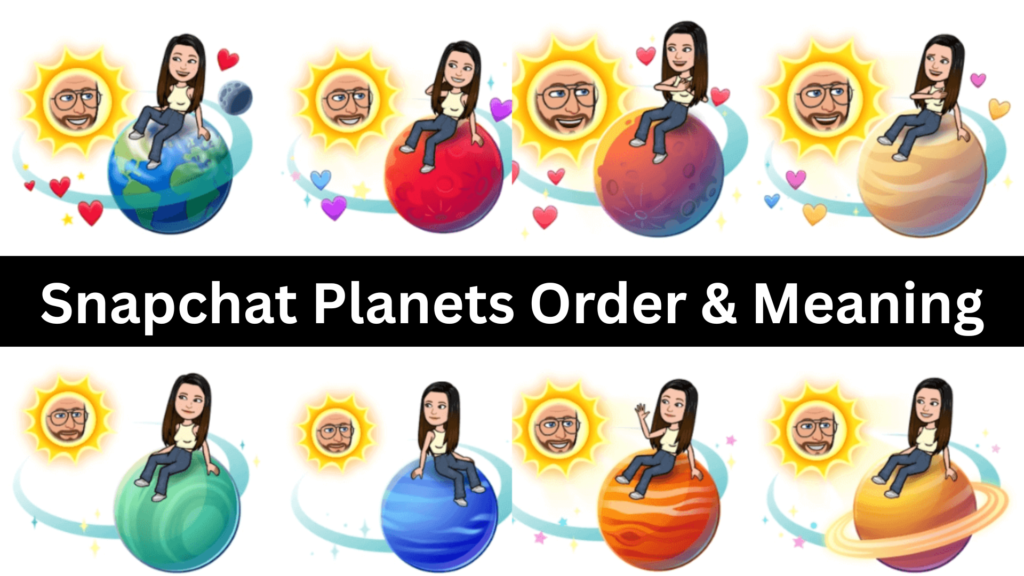
Here is the complete Snapchat planets order, from closest to furthest, and what each one means about your friendship:
1. Mercury – Your #1 Best Friend
Mercury is the closest planet to the Sun, and in Snapchat’s Solar System, it represents the person you interact with the most. Expect to see their Bitmoji surrounded by a red planet with five red hearts and glowing stars. This is your ride-or-die, your most-snapped friend on the entire platform.
2. Venus – Your #2 Best Friend
Venus is your second-closest friend, someone you connect with frequently and share genuine warmth with. The planet appears beige, brown, surrounded by multi-coloured hearts in pink, yellow, and blue.
3. Earth – Your #3 Best Friend
Earth represents steady, reliable friendship. You may not snap every single day, but when you do, it counts. Shown with red hearts and sparkly stars, this friendship is built on trust and consistency.
4. Mars – Your #4 Best Friend
Mars brings energy and excitement to the ranking. Represented by a red/orange planet with blue and purple hearts, this friend brings fire to your chat’s lively conversations, debates, and shared interests.
5. Jupiter – Your #5 Best Friend
Jupiter is the fifth planet and your fifth-closest connection. Depicted with orange-red stripes and soft stars, this friendship is still strong, just not as active as your top four.
6. Saturn – Your #6 Best Friend
Saturn is unmistakable, thanks to its iconic ring. Your sixth-ranked friend sits on this ringed orange planet with twinkling stars. A solid connection that’s still very much in your orbit.
7. Uranus – Your #7 Best Friend
Uranus represents a more occasional connection still in your top 8, but less frequent in interaction. Represented as a green planet with no hearts, this is someone you talk to here and there.
8. Neptune – Your #8 Best Friend
Neptune is the furthest planet from the Sun and marks your least-interacted best friend in the system. Interestingly, this is the only planet where your friend’s Bitmoji faces away from you a subtle nod to the distance. Still in your circle but needs a little more attention.
How to Check Your Planet in a Friend’s Solar System
Want to know where you stand in someone else’s orbit? Here’s how:
- Open Snapchat: Launch the app, then tap your friend’s Bitmoji or name to go to their profile.
- Find the badge: Look for a badge with a gold border labeled “Best Friends” or a regular “Friends” badge under their profile details.
- Tap the badge: When tapped, the badge reveals which planet you occupy in their Solar System ranking.
- Best Friends badge: This means both profiles rank in each other’s top 8 friends.
- Friends badge: This means the profile owner has you in their top 8, but they don’t appear in yours.
This simple check shows exactly how close the connection is in their Snapchat+ Solar System.
How to Enable the Snapchat Solar System Feature
The Friend Solar System is turned off by default. To activate it:
- Open Snapchat: Launch the app, then tap your Bitmoji avatar in the top‑left corner of the screen to open your profile page.
- Access Snapchat+: On your profile page, look for the Snapchat+ banner (usually near the top) and tap it. This takes you to the subscription options.
- Subscribe if needed: If Snapchat+ isn’t active yet, follow the prompts to subscribe. Once subscribed, the premium features unlock.
- Manage Features: After subscribing, go back to your profile, scroll down, and tap Manage Features under the Snapchat+ section.
- Find Friend Solar System: In the list of features, locate Friend Solar System.
- Toggle On: Tap the switch to enable it. Once activated, the Solar System will show your closest friends ranked as planets orbiting you (the Sun).
This way, the feature is not only turned on but also personalized to highlight the friends with whom the strongest connections exist.
Snapchat+ starts at around $3.99/month (pricing may vary by country).
Conclusion
The Snapchat Solar System on Snapchat is basically your social life gamified. One day you are someone’s Mercury the next day, you have drifted to Neptune because you forgot to reply. It is fun, a little chaotic, and just enough to make you send that extra snap or keep a streak alive. Use it as a playful nudge to stay connected, not a scorecard to stress over. At the end of the day, it is less about planets and more about the people you actually enjoy talking to.